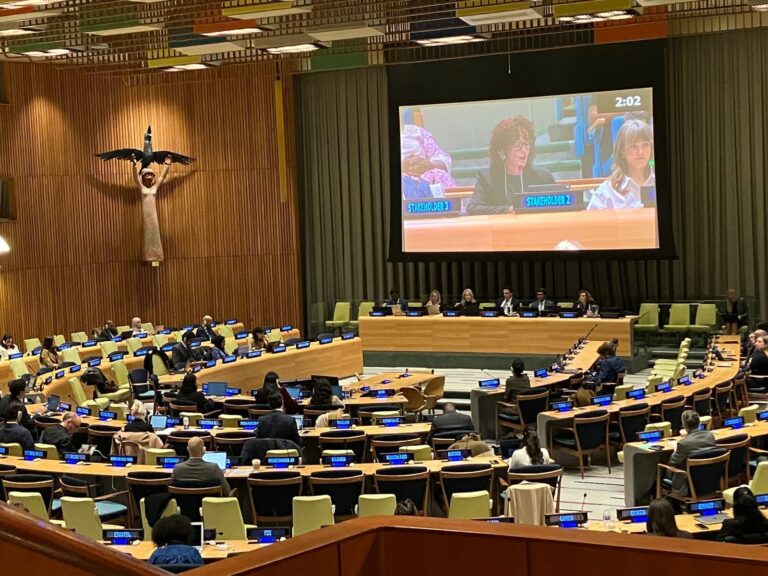
WEA’s World Freedom Network (WFN) called on States to strengthen victim-identification systems that can detect exploitation early and consistently.
The statement was made at the United Nations 80th General Assembly, during the High-level meeting on the appraisal of the UN Global Plan of Action to Combat Trafficking in Persons, on 24 November 2025.
WFN’s Oceania Director, Sarah Scott Webb, was one of only 4 representatives from civil society selected speak during the 2 days of meetings. Her statement on ‘Emerging trafficking trends’ follows:
Oral Statement
United Nations General Assembly 80th Session
High-level meeting on the appraisal of the United Nations Global Plan of Action to Combat Trafficking in Persons
24 November 2025
Delivered by Sarah Scott Webb
Excellencies and Distinguished delegates,
On behalf of the World Evangelical Alliance and the World Freedom Network, The Global Plan of Action cannot deliver on its core aims without strong, systematic victim identification. Identification needs to be the foundation: without it, prevention stalls, protection fails, prosecution collapses, partnership loses
purpose, and policy operates blindly.
As trafficking rapidly evolves, States must strengthen victim-identification systems that can detect exploitation early and consistently. This includes:
(1) expanding frontline screening beyond immigration and law enforcement to health, labor, financial, and digital-platform actors; and
(2) establishing safe, community-based referral pathways, such os OSCE’s “social path” model, where civil society can identify victims and provide protections services directly.
Two emerging issues demand urgent attention.
- Forced Criminality and Trafficking into Scamming Compounds.
Forced criminality is not new, nor are scamming compounds. What is new is the speed, scale, and unprecedented syndication now occurring across organised criminal networks – rapid cross-border transfers, shared digital infrastructure, and industrial-level coercion. Many victims remain unidentified because their exploitation is hidden behind a criminal veneer.
Two actions are essential:
(1) State adoption of non-punishment provisions that explicitly cover victims exploited in online fraud and scamming operations; and
(2) We need much stronger coordinated, cross-sector collaboration to replace the current fragmentation that is preventing our sector from making significant progress. - The Escalating Transnational Organised Crime in the Pacific
The Pacific is experiencing a sharp rise in transnational organized crime; including drug trafficking, labor exploitation, cyber-enabled crime, and increasing child trafficking. Yet victims remain statistically invisible because Pacific data is routinely folded into East Asia, making accurate victim identification nearly impossible.
Two actions are urgently needed:
(1) commit to systematic, Pacific-specific data collection and analysis,
and recognise the region as a priority for TNOC disruption; and
(2) establish safe, community-based referral pathways where civil society can identify victims early and trigger protection responses directly.
If the GPA is to remain credible and future-focused, strengthening victim identification, across all contexts, must be its central operational priority.